This is an open access journal, which means that all content is freely available without charge to the user or his/her institution. Users are allowed to read, download, copy, distribute, print, search, or link to the full texts of the articles, or use them for any other lawful purpose, without asking prior permission from the publisher or the author. This is in accordance with the BOAI definition of open access.
Authors’ Guide
Open Access Statement
Scope
The subjects should be of interest for the research or technology development community in any of these areas: Computer Sciences, IT, Biomedical engineering, Telecommunications or Electronics.
Types of the received articles:
Scientific or technological research article
In which it is informed, in a detailed form, of original relevant results from scientific research or technological development. Their usual structure has four sections: introduction, methods, results and conclusions.
Reviewing article
Document consequence of literature review where results, from published or unpublished research, of a specific science or technology field, are analyzed and systematized; with the purpose of informing of the advances and development tendencies in the field. They are characterized by a careful biographic selection.
Reflection article
Papers with an analytic perspective, critical or interpretative, about the results of a specific research or technological development theme, from the author or others, for which the author carry out a methodical follow-up in order to present: consistency or inconsistencies, an extension, a modification or the proposition of a new perspective.
Policies for the Submission of Manuscripts
Contributions are considered for publication when they have not been previously published, and are not currently submitted for its publications on any other media.
The acceptance is conditioned to the results of a double blind peer-reviewing process of at least two experts that can be of external institutions.
Reviewers consider the relevance of the paper for the scientific and technology development community, same as its quality.
No charge in the publishing process.
Editorial Process
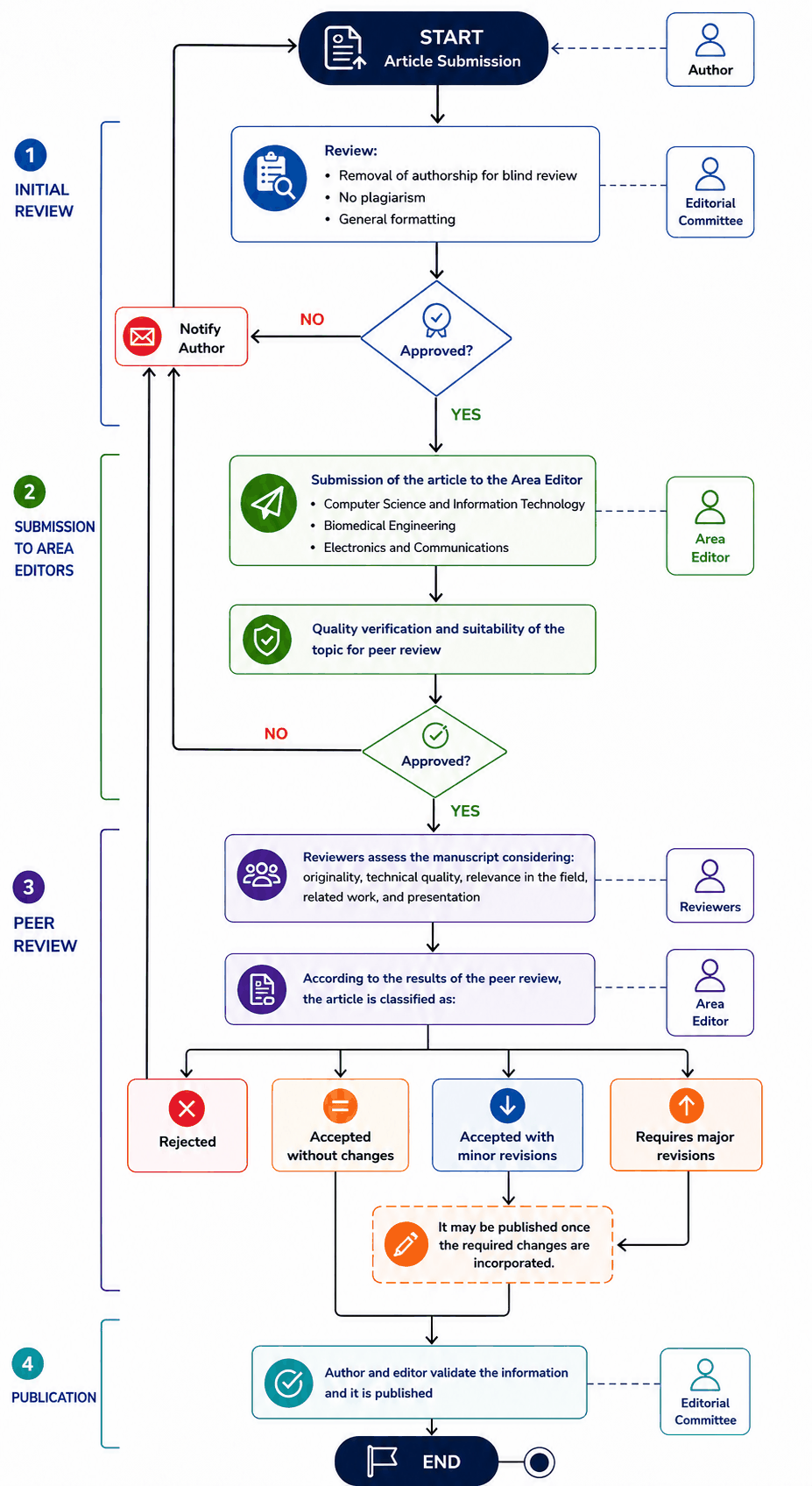
Publishing is continously. However, numbers are closed in tthe months of April, Agost, and December.
The process takes a time approximately from 3 to 6 months, from the paper reception to its publishing

Copyrights and Author Responsabilities
Authors retain copyright and grant the University of Guadalajara the right of first publication of the work, also guaranteeing the right to its dissemination and distribution under a Creative Commons CC BY-NC-SA 4.0 license. Download publication agreement.
After accepance, it is necessary to attach the publication agreement signed by all author.
The authors are responsible for the accuracy of the information contained in the paper, the ideas and opinions expressed therein, as well as access to other websites contained therein.
Prior to publication, authors are responsible for obtaining copyright permission if their illustrations, tables, or extensive quotations from the material have been published elsewhere. Authors must obtain permission to reproduce from both the author and the source that published it.
Corrections and Retractions Policy
Once an article has been officially published, it cannot be modified. However, in accordance with the guidelines of the Committee on Publication Ethics (COPE), the following mechanisms are available to address situations after publication:
Corrections (Errata): A formal correction note will be published when an unintentional error or honest omission is detected on the part of the authors or the editorial team (for example, a typo in a name, a minor detail in a table, or a formatting error) that does not affect the methodological validity or the fundamental conclusions of the study. The correction note will be linked bidirectionally to the original article.
Retractions: An article will be publicly and definitively retracted if a serious breach of scientific integrity is demonstrated. Reasons for retraction include, but are not limited to: plagiarism or self-plagiarism exceeding permitted limits, fabricated or manipulated data, falsification of authorship, systematic inclusion of false citations, or methodological errors so serious that they completely invalidate the results. The original article will not be removed from the website for historical record purposes, but it will be overlaid with an indelible watermark bearing the word "RETRACTED," along with a formal statement from the Editorial Committee explaining the reasons.
Exceptional Cases (Content Removal): The complete removal of a PDF/HTML file from the platform is a measure that will only be carried out under an express legal order, when the content directly infringes on the privacy rights of third parties, poses serious biosafety/technological risks, or constitutes a flagrant violation of intellectual property law that cannot be remedied through retraction.
Errata requested by authors: Authors who identify a critical error in their already published article must immediately notify the Editorial Committee via the journal's official email, presenting a clear justification and the proposed correction for evaluation
Ethics Guidelines
ReCIBE is committed to respecting and complying with the rules of ethical conduct at all stages of the publication process. In this regard, we closely follow the Publication Ethics Committee (COPE), which sets the standards and provides guidelines to follow in order to meet these requirements.
Manuscript Preparation: General Guidelines
Manuscript Language
The manuscript can be submitted in Spanish, English, or both languages.
Plagiarism
The manuscript will be subject to a plagiarism check. Similarity to any other published document must not exceed 20%.
Editorial Review
Once a manuscript is received, the editorial team conducts a preliminary review to verify that the submission falls within the journal’s focus and scope, meets the formal submission requirements, includes the requested documentation, and complies with ReCIBE’s editorial and ethical policies.
Once these requirements have been met, the manuscript is sent for peer review.
Double-Blind Review
The submitted document must not include any information that identifies the authors.
Self-references must be written as if they were references to third parties.
Evaluation Criteria
Our reviewers will formally evaluate manuscripts based on four explicit criteria: originality, technical quality, relevance to the field, and clarity of presentation, in addition to issuing any general recommendations they deem pertinent.
The guidelines for reviewers and the peer review process can be consulted in Guidelines for Reviewers and Peer Review Process.
Use of Artificial Intelligence
Recommendations for reporting the use of Artificial Intelligence in the article or essay
In accordance with the Guide for the regulation of the use of Artificial Intelligence in scientific journals of social sciences, in peer review processes and to report its use in scientific texts, prepared by Liana Penabad-Camacho, María Morera-Castro and María Amalia Penabad-Camacho (2024), authors must incorporate the following protocol into articles or essays that have used artificial intelligence as a complement to the research or writing process.
According to Penabad-Camacho et al. (2024), this protocol is based on the principles that only human beings can assume authorship, that only uses of Artificial Intelligence filtered through the expert judgment of the authors are accepted, and that evidence of how AI was used must be provided.
Checklist of recommendations and good practices for reporting the use of AI in scientific articles or texts resulting from research or documentary review/analysis:
| Scientific Document Section | Criteria | Recommendation |
|---|---|---|
| Title | Precision | When the use of AI is decisive for the content of the document, evidence it in the title. |
| Abstract | Structured Abstract | Mention the use of AI in each section of the abstract where it has relevant or strategic value to the content. |
| Introduction | Context | Describe and explain the use of AI in your paper. Explicitly explain and identify whether AI has been used to assist writing, transform information, or perform analysis. |
| Introduction | Aims | Explicitly mention why AI is used or include an explicit aim that explains the purposes for using AI in your article. |
| Background | Contextualization |
Report which sources of contextualization were provided by AI (according to fair use). If AI was used, make it visible in the criteria for use, delimitation, and ethical considerations described in the Methodology. |
| Background | Conceptualization |
Report which sources of conceptualization were provided by AI (fair use). If AI was used, make it visible in the criteria for use, delimitation, and ethical considerations described in the Methodology. |
| Background | Identify the model | Explicitly mention the language model (LLM), the version used, and the date(s) of use. Cite author and year according to APA (2020). See the References section. |
| Methodology | AI's Role |
Unfiltered use of AI should not be accepted or considered valid. Filtered use of AI: Report the criteria for use (inclusion or exclusion) and filtering of the information to guarantee its relevance and validity. Consider these parameters:
|
| Methodology | Query or Prompt |
|
| Methodology | Analysis of results | Establish the inclusion or exclusion criteria for the data obtained in response to the initial prompt, secondary prompts, or network of prompts. |
| Methodology | Ethical considerations |
|
| Results | Report results |
Explain which products presented, results, or systematization of results come from the material requested from the AI. If you have produced tables and figures with AI assistance, mention its use in a table or figure note. Example: Note: Prepared with assistance of [Model name, version and date] (Author, year). |
| Discussion | Discussion |
Report whether you asked the AI model to complement the discussion of your writing considering any of these dimensions:
|
| Conclusions | Report: synthesis or systematization | Report whether you asked the AI model to synthesize, summarize, or systematize arguments, limitations, and recommendations to complement the elaboration of conclusions in your writing. |
| Statements | Artificial Intelligence Use Statement |
Clarify conflicts of interest, disclaimers, or any aspect related to the use of AI. Example: Artificial Intelligence was used to assist the research process and writing of this manuscript. Assisted by [Model name, version and date], its use was mediated by humans. |
| References | According to APA Style, 7th edition |
Use the following reference structure for the AI model (or models) used: Algorithm issuer. (year). Model name (version month day) [Language model]. https://... Example: OpenAI. (2023). ChatGPT (version May 21) [Language model]. https://chat.openai.com/auth/login In the text mention: Author (year) or (Author, year): OpenAI (2023) or (OpenAI, 2023). |
Submission Format
- The manuscript must be submitted in PDF or Word format.
- The text must be presented in a single column.
- Sections must be numbered avoiding inserting unnecessary breaks between sections.
Manuscript Structure
Title
- Must be clear and concise, presented in both Spanish and English.
Abstract
- Maximum of 250 words.
- Should briefly include the objectives, methodology, results (if applicable), and significance.
- References are not allowed.
- Must be presented in both Spanish and English.
Keywords
- A minimum of 3 and a maximum of 8 keywords, in both Spanish and English.
Visual Elements
Tables and Figures
- Must be numbered consecutively in the order they appear in the text.
- Should be placed where they will be published, respecting the document’s margins.
- Content must be fully visible.
- Captions: They should be placed at the top of the tables and at the bottom of the figures, starting with: Table 1. Description... or Figure 1. Description....
Equations
- Must be numbered consecutively, with the number in parentheses on the right-hand side.
- Should be presented as graphics with a resolution of 600 dpi.
Audio and Video Material
- Maximum recommended size: 10-12 MB per file.
- Accepted formats:
- Video:
.mpg,.qt,.mov. - Audio:
.wav,.mp3,.wma.
- Video:
- A maximum of two files is allowed.
- This material must be referenced explicitly in the text.
Footnotes
- Use only when absolutely necessary for clarifications or additional information that would disrupt the main text.
- Must be numbered consecutively and placed at the end of the main text, not at the bottom of each page.
References
- References must follow APA format.
- Further details are available at www.apastyle.org.
Document Length
- There is no minimum or maximum length requirement.
- If the manuscript exceeds 30 pages (including illustrations and references), a brief written justification must be provided explaining why it is not feasible to shorten the document.
Final Instructions
- Once accepted for publication, specific instructions for preparing the final format will be provided.
- The revised manuscript must be uploaded in Microsoft Word format for publication.